Bali KBLI Restricts New PMA Licensing Across 18 Codes: What Foreign Investors Need to Know
Bali’s restriction on new PMA licensing for 18 specified KBLI classifications is a targeted OSS administrative measure, not a blanket prohibition on foreign investment or an automatic cancellation of existing licences. The restriction particularly affects selected small-scale accommodation, real estate, consultancy, vehicle rental, retail, café, tailoring and sports activities, while important questions remain regarding licence amendments, additional KBLI applications, virtual offices and the transition to KBLI 2025. Foreign investors should therefore verify the actual principal activity, current OSS treatment, site-specific permits and operating structure before incorporating a company, leasing premises or committing capital, and should avoid nominee arrangements, permit lending or artificial KBLI classifications designed solely to bypass the restriction.


The Bali Provincial Government has implemented a restriction preventing foreign investment companies, or PT PMA, from submitting new business-licensing applications through the Online Single Submission system for 18 specified business classifications in Bali.
The restriction reportedly became effective across the province from the third week of May 2026. It covers selected accommodation, property, consultancy, vehicle-rental, retail, food-and-beverage, tailoring and sports-related activities that the provincial government considers closely connected to the commercial space traditionally occupied by local micro, small and medium enterprises.
This development is significant, but it should not be described as a blanket prohibition on foreign investment in Bali. The current measure is more accurately understood as a targeted restriction on new OSS licensing access for particular KBLI activities undertaken by PMA companies in Bali.
Background to the Restriction
On 28 January 2026, the Governor of Bali issued Letter No. B.27.000/642/PM/DPMPTSP to the Minister of Investment and Downstreaming/Head of the Investment Coordinating Board, or BKPM.
The letter followed an investment-control memorandum between the Ministry of Investment/BKPM and the Bali Provincial Government. It referred to the large number of PMA registrations in Bali, particularly projects classified as low risk, and expressed concern that certain companies were using easily obtained Nomor Induk Berusaha, or NIB, registrations without carrying out substantive investment activities.
The Governor requested that OSS access be closed for:
PMA companies conducting low-risk and medium-low-risk activities in Bali; and
PMA companies using virtual offices as their business locations in Bali.
However, the January letter should not be treated as the final operative list of restricted business activities. It referred to several KBLI codes as examples and requested a considerably broader closure. The policy subsequently announced by the Bali Provincial Government in July 2026 is narrower and identifies 18 specific KBLI classifications.
According to the provincial government, the restriction was implemented after approval was obtained from the Minister of Investment and Downstreaming/Head of BKPM. The publicly available announcement does not, however, identify the number of the ministerial approval or publish detailed OSS implementation instructions.
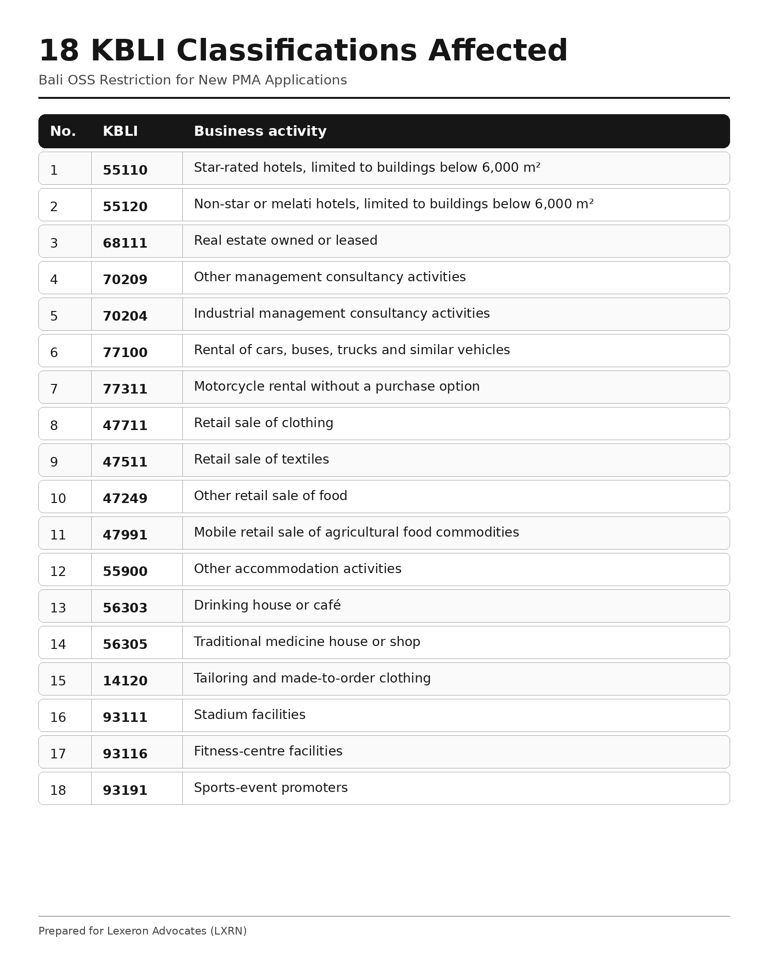
The 18 KBLI Classifications Affected
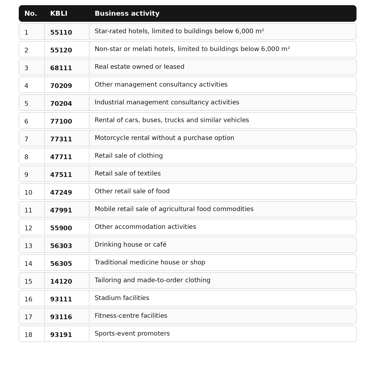
The current list announced by the Bali Provincial Government comprises the following classifications:
This article is provided for general informational purposes and does not constitute legal advice. The regulatory and OSS position should be verified for each proposed business and location.
What Does “Closure of OSS Access” Mean?
The measure prevents a PMA company from applying through OSS for new business licensing in Bali under one of the listed KBLI classifications, until a further policy is issued. It is important to distinguish this from several different legal concepts.
Firstly, the restriction is not presently framed as a nationwide foreign-ownership limitation. Indonesia’s national investment framework continues to provide that commercial business fields are generally open to investment unless they are expressly closed, reserved for the Central Government or subject to conditions under Presidential Regulation No. 10 of 2021, as amended by Presidential Regulation No. 49 of 2021.
Secondly, the policy does not amend the national Positive Investment List on its face. Instead, it operates through the administration of the OSS system for projects located in Bali, following coordination between the provincial government and the Ministry of Investment/BKPM.
Thirdly, the announcement does not state that business licences already issued under the affected classifications are automatically revoked. Existing companies remain required to submit their Investment Activity Reports, or LKPM, until the relevant KBLI is formally deactivated or removed from their business licensing.
The treatment of amendments, expansions, relocation applications and the addition of a restricted KBLI to an existing PMA company has not been explained in sufficient detail in the public announcement. In practice, those transactions may still be treated as applications for new or amended business licensing and should be checked directly through the current OSS process.
Interaction with Indonesia’s Risk-Based Licensing System
Indonesia’s current risk-based licensing framework is governed principally by Government Regulation No. 28 of 2025 on the Administration of Risk-Based Business Licensing, which replaced Government Regulation No. 5 of 2021. Government Regulation No. 28 of 2025 regulates business licensing, supporting licences, basic requirements, OSS services, supervision, evaluation and administrative sanctions. Its OSS procedures are further addressed under Minister of Investment and Downstreaming/Head of BKPM Regulation No. 5 of 2025.
The Bali Government’s stated concern relates particularly to low-risk activities, for which an NIB may constitute the principal business licence, and medium-low-risk activities, which generally require an NIB and standard certification. According to the provincial government, the relative ease of obtaining these registrations had allegedly been used by some foreign investors to enter small-scale sectors without making the substantive investment expected of a PMA company.
The KBLI 2025 Transition
The announced Bali restriction uses codes and activity descriptions associated with KBLI 2020. However, the Central Statistics Agency issued KBLI 2025 through BPS Regulation No. 7 of 2025, which came into force in December 2025 and replaced BPS Regulation No. 2 of 2020. The government has stated that the implementation of KBLI 2025 is being integrated into OSS and that existing businesses should not be required to obtain entirely new licences solely because of the classification transition.
Nevertheless, foreign investors must assess how an existing or proposed KBLI 2025 activity maps against the 18 restricted KBLI 2020 codes. A business should not assume that a newly worded or reorganised KBLI 2025 classification falls outside the restriction merely because its code or title has changed. The correct classification must be determined by the business’s actual principal activity, products, operational process, premises and revenue model.
Key Implications for Foreign Investors
Food-and-Beverage Businesses
The restriction expressly includes KBLI 56303 for drinking houses or cafés and KBLI 47249 for other food retail activities. It does not expressly prohibit every food-service or restaurant classification. This distinction may be relevant to businesses preparing meals or food for immediate consumption, as opposed to businesses principally providing beverages or selling retail food products. However, selecting another KBLI is defensible only where that classification genuinely corresponds to the operation.
A café cannot lawfully avoid the restriction merely by registering itself as a restaurant or food retailer while continuing to conduct a principally beverage-based business. Conversely, a food-service operation should not automatically be classified as a café merely because it sells coffee as an ancillary product.
Hotels and Accommodation
The announced restriction applies to KBLI 55110 and 55120 where the relevant hotel building is below 6,000 m². Investors considering smaller hotel, boutique accommodation or similar developments should therefore verify not only the KBLI but also the applicable scope, building size, risk classification and sectoral standards. KBLI 55900 for other accommodation activities is separately included and may affect certain guesthouse, short-stay or alternative accommodation structures.
Real Estate
KBLI 68111, covering real estate owned or leased, is among the restricted activities. This may affect newly proposed PMA structures involving the commercial operation, leasing or management of property under that classification. The restriction does not itself alter Indonesian land-ownership law. However, it may affect whether a newly established PMA company can obtain the required business licensing for the intended commercial real-estate activity in Bali.
Consultancy and Service Companies
Both KBLI 70209 and 70204 are included. Foreign investors should not assume that describing a commercial operation as “consultancy” or “management services” provides a simple alternative to registering the underlying regulated business activity. The company’s registered KBLI must reflect the services it actually performs. Authorities may examine contracts, invoices, employees, revenue streams, physical operations and immigration sponsorship when determining whether the registered activity corresponds with the real business.
What About Virtual Offices?
The Governor’s January letter requested the closure of OSS access for PMA companies using virtual offices in Bali. The later provincial announcement is more cautious: it states that PMA activities using virtual offices will receive particular attention as part of strengthened licensing supervision. On the presently available public information, it would therefore be premature to state that all virtual-office use by PMA companies in Bali has been categorically prohibited.
Nevertheless, PMA companies using a virtual office should expect increased scrutiny regarding whether the address is legally suitable for the registered activity, whether the business has a genuine operational location and whether its licensing, tax, employment and immigration arrangements correspond with its actual activities.
Structures That Should Be Avoided
The restriction should not be addressed through nominee arrangements, permit lending or artificial classification. Using an Indonesian shareholder merely as a formal owner while the foreign investor retains undisclosed beneficial control may create serious corporate, contractual, licensing and enforcement risks. Similarly, operating through another company’s NIB without making that company the genuine licensed operator may be regarded as misuse of business licensing.
Where a foreign-owned business cannot obtain the relevant KBLI, a commercial arrangement with an existing Indonesian operator may sometimes remain possible. However, the arrangement must clearly allocate operational control, revenue collection, taxation, employment, brand ownership, premises rights and regulatory responsibility. It cannot function merely as a façade through which an unlicensed party conducts the restricted business.
LXRN View
The Bali restriction reflects a broader shift toward closer scrutiny of small-scale foreign-owned businesses operating in sectors associated with local enterprises. Foreign investors should therefore expect authorities to look beyond corporate documents and examine whether the scale, capitalisation and substance of a PMA operation are consistent with its registered business activities.
At the same time, the policy leaves several issues requiring further clarification. The official announcement confirms ministerial approval but does not publish the relevant approval instrument, technical OSS direction or detailed transitional provisions. It also does not fully address amendments to existing licences, additional KBLI applications, corporate restructurings or the mapping of the restricted codes under KBLI 2025. Accordingly, the restriction should be treated as an operative administrative barrier within OSS, but not overstated as a blanket closure of Bali to foreign investment or as an automatic cancellation of existing PMA licences.
Before incorporating a company, acquiring a business or committing funds to premises in Bali, foreign investors should now conduct a threshold review covering:
the genuine principal business activity;
the applicable KBLI 2025 and its relationship to the restricted list;
the current OSS treatment at the proposed location;
whether the project involves a new or amended licence;
applicable sectoral, spatial and building approvals;
the proposed operating and revenue structure; and
the immigration status of any foreign person actively managing the business.
Where the intended activity falls within or close to one of the restricted classifications, this assessment should be completed before leases, construction arrangements, franchise agreements or investment commitments are executed.
Conclusion
Bali remains open to foreign investment, but the provincial government is drawing a clearer distinction between substantive investment projects and small-scale activities considered more appropriately undertaken by local businesses. The closure of OSS access for 18 KBLI classifications represents a material change for foreign investors in Bali. It also reinforces the importance of selecting a KBLI based on the real operation rather than the preferred licensing outcome. Because implementation is taking place administratively through OSS and further guidance may be issued, each proposed investment should be assessed against the live licensing position at the time of application.
Principal Sources
Government of Bali, Governor’s Letter No. B.27.000/642/PM/DPMPTSP dated 28 January 2026.
Government of Bali, “Governor Koster Restricts OSS Access for PMA in Certain KBLI,” 23 July 2026.
Government Regulation No. 28 of 2025 on the Administration of Risk-Based Business Licensing.
Minister of Investment and Downstreaming/Head of BKPM Regulation No. 5 of 2025.
Presidential Regulation No. 10 of 2021, as amended by Presidential Regulation No. 49 of 2021.
BPS Regulation No. 7 of 2025 on the Indonesian Standard Industrial Classification.
ANTARA, “Bali Closes Licensing for 18 Foreign-Investment Business Activities,” 23 July 2026.