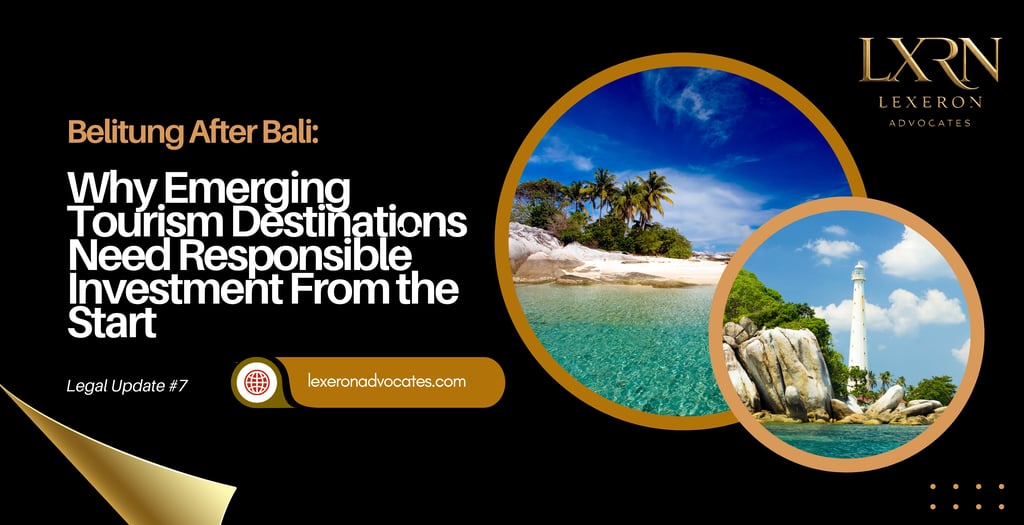
Belitung After Bali: Why Emerging Tourism Destinations Need Responsible Investment From the Start
Belitung is gaining attention as an emerging tourism and investment destination, but its growth should not simply repeat Bali’s path. This article explores why responsible investment, proper legal structure, land verification, licensing compliance, and local participation are essential for Belitung to grow better from the beginning.
Belitung is entering a more visible phase in Indonesia’s tourism and investment landscape. With renewed international access through Singapore, growing Australia-originating connectivity via Singapore, recognition as part of the UNESCO Global Geoparks network, and the continued development of Tanjung Kelayang Special Economic Zone, Belitung is increasingly relevant to hospitality groups, property investors, tourism operators, and foreign businesses looking beyond Bali.
This momentum should be welcomed. However, the more important question is not merely whether Belitung can attract investment, but whether it can attract the right kind of investment. For emerging destinations, the quality of investment often matters more than the speed of investment. Capital can accelerate growth, but without proper legal structure, spatial planning, licensing discipline, environmental awareness, and local participation, the same capital can also create disputes, regulatory exposure, and long-term pressure on the destination itself.
Indonesia has already seen this tension in Bali. Bali remains one of Indonesia’s most successful tourism destinations, but it also provides a clear legal and commercial lesson for other regions. Tourism growth can create employment, infrastructure, foreign interest, and commercial value. At the same time, when development moves faster than planning and governance, it may also produce land issues, zoning violations, licensing problems, environmental pressure, infrastructure congestion, and tension between investors, local partners, communities, and regulators.
For Belitung, the objective should not be to become “the next Bali.” The more important objective is to build better from the beginning.
Belitung’s Investment Appeal
Belitung has a distinct investment profile. Its appeal is not based on copying Bali, but on offering a different type of destination: coastal tourism, island-hopping, marine activities, geopark-based travel, boutique hospitality, eco-tourism, cultural tourism, and locally rooted economic development. This distinction is important because Belitung should not be positioned merely as a cheaper alternative to Bali or as a speculative land bank for investors who missed earlier opportunities in more mature markets.
The island’s natural assets remain central to its value. Belitung is known for its granite rock formations, beaches, surrounding small islands, marine ecosystem, local culture, and relatively less saturated tourism market. UNESCO describes Belitong UNESCO Global Geopark as a land-and-sea geopark shaped by geological diversity, marine ecosystems, mangrove forests, seagrass beds, coral reefs, surrounding islands, and distinctive granite landscapes. These qualities support the island’s long-term potential as a nature-based and culturally grounded destination, rather than a purely property-driven tourism market.
Belitung also benefits from strategic policy positioning. Tanjung Kelayang Special Economic Zone has been developed as a tourism-focused SEZ in Bangka Belitung. When the SEZ was inaugurated, the Government described it as part of an effort to transform the provincial economy from a tin-mining-based economy into one supported by world-class tourism. The same government statement also referred to expected investment value and employment generation, showing that Belitung has long been positioned as part of Indonesia’s broader tourism diversification agenda.
The recent improvement in international access strengthens that positioning. In May 2026, ANTARA reported the inaugural Singapore–Tanjungpandan Scoot flight, with Indonesia’s Ambassador to Singapore describing Belitung as being around 50 minutes away by flight from Singapore. Time Out Melbourne also reported that Scoot would launch flights from Perth, Sydney, and Melbourne to Belitung via Singapore, making Belitung more visible to Australian travellers and, by extension, to investors who follow tourism connectivity and visitor flows.
However, improved access should not be confused with automatic investment readiness. A destination may become easier to reach before it becomes easier to invest in. The legal, land, licensing, environmental, and commercial framework behind each project still needs to be reviewed carefully.
The Lesson From Bali
Bali shows that tourism success can bring both economic growth and structural pressure. Over the years, Bali has attracted foreign investors, domestic developers, hospitality operators, restaurants, villas, beach clubs, wellness businesses, and property-related ventures. Many of these projects have created real commercial value and employment, but the same growth has also exposed recurring issues around land use, licensing, infrastructure, waste, congestion, local community concerns, and regulatory enforcement.
These concerns are not merely theoretical. In 2024, Reuters reported that the Indonesian Government had agreed to set a moratorium on the construction of hotels, villas, and nightclubs in certain areas of Bali as part of a response to over-development and the need to improve tourism quality while preserving local culture. The discussion around Bali’s moratorium is significant because it shows that once a destination becomes commercially overheated, regulatory pressure often follows.
For investors, the lesson is not that tourism investment should be avoided. The lesson is that legal and commercial structuring must come before capital deployment, marketing, construction, or partnership commitments. Many disputes do not begin in court, at the police station, or when the project has already failed. They begin much earlier, when parties rely on trust, informal arrangements, incomplete land checks, unclear authority, or contracts that do not reflect the real business relationship.
This is especially relevant for emerging destinations such as Belitung. If the legal structure is weak at the beginning, the problem may only become visible after money has been paid, land has been used, construction has started, permits have been questioned, or local relationships have deteriorated. By that stage, the dispute is usually more expensive, more complex, and more damaging to the project.
Responsible Investment Is Not Anti-Growth
Responsible investment does not mean rejecting development. It means ensuring that development is properly structured, properly licensed, commercially disciplined, and locally responsible. Belitung needs investment, hospitality projects, infrastructure, local employment, and business activity. The issue is not whether investors should come, but how they should enter.
Tourism and property projects in Indonesia are rarely simple commercial transactions. They often involve land law, spatial planning, business licensing, environmental obligations, corporate structure, foreign ownership restrictions, tax, employment, construction risk, immigration considerations, and local community dynamics. Treating these issues as administrative details rather than core investment risks is one of the most common mistakes made by investors entering emerging markets.
Indonesian investment law itself reflects principles that are relevant to this discussion, including legal certainty, transparency, accountability, sustainability, environmental awareness, and balanced national economic development. These are not only policy language; they are practical considerations that should shape how investment is structured, documented, licensed, and implemented.
For foreign investors, the structuring issue is even more important. Indonesian law generally requires foreign investment to be conducted through an Indonesian limited liability company established under Indonesian law and domiciled in Indonesia, unless otherwise provided by law. This means that the investor’s legal vehicle, business field, shareholding structure, licensing classification, and operational model must be assessed before commitments are made.
A structure that looks simple commercially may not be legally suitable. Likewise, an arrangement that is “common in practice” may still be difficult to enforce if it conflicts with Indonesian land, investment, licensing, or corporate law.
Key Legal Considerations for Investors Looking at Belitung
Investors considering Belitung should begin with land verification. This includes reviewing title, ownership history, boundaries, encumbrances, tax status, access, existing occupation, disputes, and permitted land use. Indonesian land law remains grounded in the Basic Agrarian Law, and any tourism or property project must be assessed against the relevant land rights and the legal capacity of the parties involved.
Spatial planning and licensing should also be reviewed before a project is marketed, funded, or built. Indonesia applies a risk-based business licensing framework, and Government Regulation No. 28 of 2025 regulates the implementation of risk-based business licensing through requirements that may include basic requirements, business licenses, supporting licenses, OSS system services, supervision, evaluation, and sanctions. Investors should not only ask whether a business idea is commercially attractive, but also whether the intended activity, location, scale, and risk classification can be supported by the correct approvals.
Foreign investment structuring must also match the investor’s real objective. A resort, restaurant, villa development, land lease, management arrangement, joint venture, marine tourism service, or supporting infrastructure business may each require a different legal approach. Investors should assess whether a PT PMA is required, whether the proposed business activity is open to foreign investment, and whether the structure can support licensing, tax, employment, immigration, and operational needs.
The business field analysis is particularly important because Indonesia’s investment framework distinguishes between business fields that are open, prioritized, allocated or partnered with cooperatives and MSMEs, subject to requirements, or excluded from investment. This framework is reflected in Presidential Regulation No. 10 of 2021, as amended by Presidential Regulation No. 49 of 2021, and should be checked against the relevant KBLI and the actual activities to be conducted.
Local participation should also be structured transparently. Local landowners, vendors, community members, operators, contractors, and business partners can play an important role in responsible investment, but the legal relationship must be documented clearly. Roles, authority, capital contribution, revenue sharing, asset ownership, operational control, termination rights, exit rights, and dispute resolution should be addressed from the beginning.
Environmental and community considerations should form part of the investment strategy. For destinations built around natural beauty, environmental degradation is not only a moral or reputational issue; it is also a commercial risk. A destination that loses its nature, identity, and social balance may also lose the very value that attracted investors in the first place.
Belitung Should Not Be Treated as a Backup Plan After Bali
One of the risks for Belitung is that investors may see it merely as a cheaper alternative to Bali. That approach would be legally and commercially short-sighted because Belitung has its own land context, local economy, environmental sensitivity, cultural identity, and regulatory pathway.
Belitung should not be treated as a speculative land bank or a simplified version of Bali. Serious investors should approach the island as a distinct destination that requires its own due diligence, stakeholder mapping, licensing review, and long-term business strategy. The opportunity is not only to enter early, but to enter properly.
Bali’s experience should not discourage investment in Belitung. It should improve the quality of investment entering Belitung. Mature destinations often show what emerging destinations should protect, and Belitung still has the opportunity to structure growth before the market becomes too crowded, too informal, or too reactive.
LXRN Insight
At Lexeron Advocates, we believe emerging investment destinations require more than capital. They require legal structure, regulatory compliance, contractual clarity, and long-term responsibility.
For Belitung, responsible investment should begin before construction, marketing, land payment, or operational launch. Proper due diligence, land verification, corporate structuring, licensing review, environmental awareness, and clear contractual documentation are not formalities; they are the foundation of sustainable investment.
The future of Belitung should not be measured only by how many investors enter, how many villas are built, or how quickly tourism numbers grow. It should also be measured by whether the island can grow without losing the qualities that make it attractive in the first place.
Belitung should not become the next Bali. It should become the better lesson after Bali.
Sources
Time Out Melbourne, “Melbourne is scoring new flights to two of Indonesia’s most underrated gems”
ANTARA News, “Ambassador: Belitung now just 50 minutes by flight from Singapore”
UNESCO, “Belitong UNESCO Global Geopark”
United Nations Indonesia, “Introducing Belitong Island: Indonesia’s Newest UNESCO Global Geopark”
Cabinet Secretariat of the Republic of Indonesia, “Gov’t Inaugurates Tanjung Kelayang SEZ in Bangka Belitung”
Reuters, “Bali to ban building of some hotels to tackle over-development”
Law No. 25 of 2007 on Investment
Law No. 5 of 1960 on Basic Agrarian Principles
Presidential Regulation No. 10 of 2021 on Investment Business Fields
Presidential Regulation No. 49 of 2021 amending Presidential Regulation No. 10 of 2021
Government Regulation No. 28 of 2025 on Risk-Based Business Licensing
Legal Disclaimer
This article is intended for general information only and does not constitute legal advice, investment advice, property marketing, brokerage activity, or an offer to sell securities, property, or investment products. Any investment in Indonesia should be supported by specific legal, tax, financial, land, licensing, and regulatory review based on the actual facts of the proposed project.
-----